
click the image to view fullscreen
Bubble Nebula — A Structure in Motion
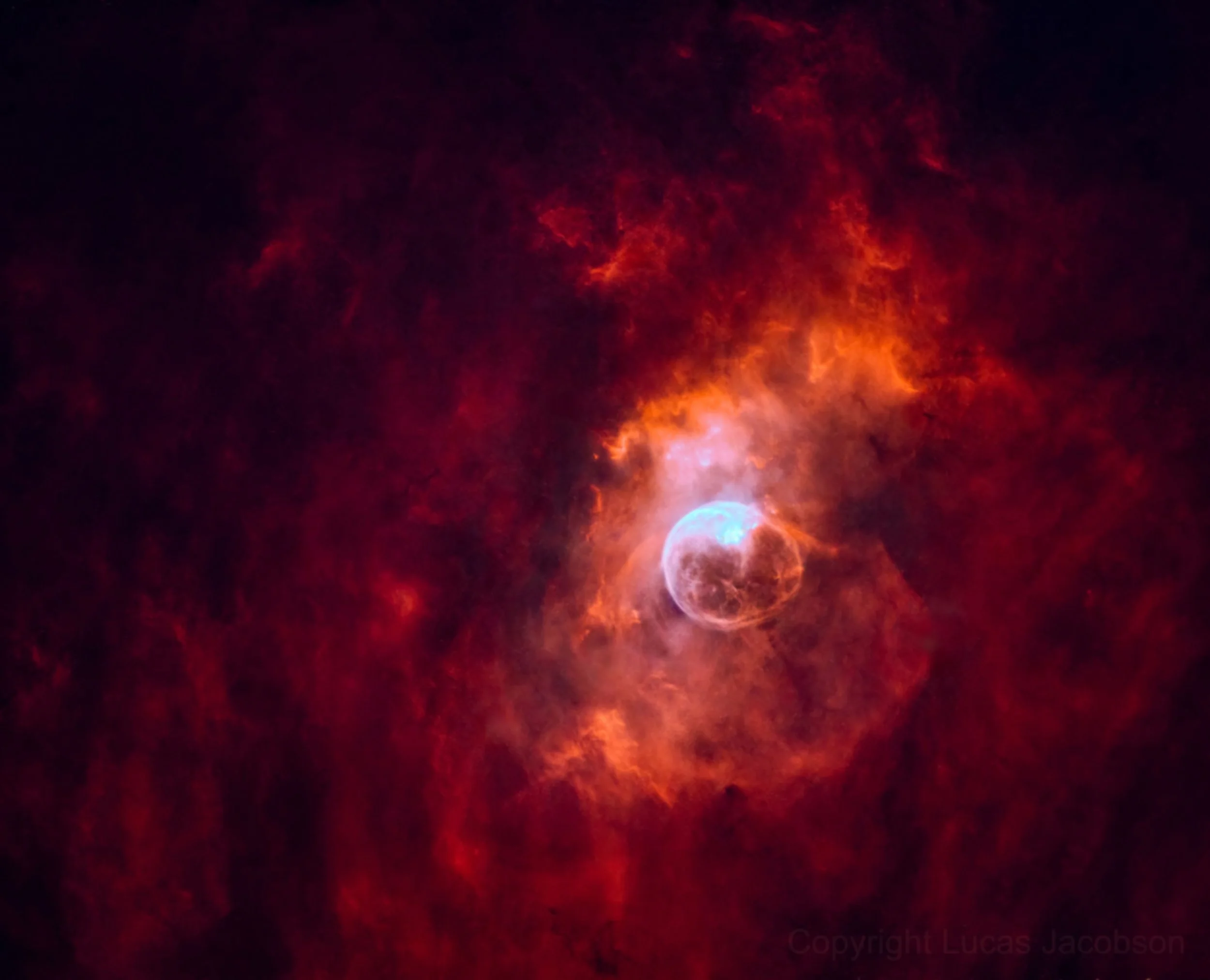
The Bubble Nebula is formed by the intense stellar wind of a massive star, which drives a shock front into the surrounding gas. Over time, this outward pressure creates a spherical cavity—what appears as a “bubble” suspended within a larger nebular environment.
In this starless rendering, the surrounding stars are removed to focus attention entirely on the structure itself. Without those points of reference, the nebula takes on a more fluid, sculptural form, revealing the delicate interaction between expanding gas and the denser material around it.
Hydrogen emission defines the broader cloud, while oxygen traces regions of higher energy where the shock front interacts more directly with its surroundings. The contrast between these layers highlights the uneven expansion of the bubble, shaped as much by the environment as by the star driving it.
Rather than a perfect sphere, the bubble appears distorted and incomplete—evidence of resistance in the surrounding medium. This is not an isolated object, but a local disturbance within a much larger field of gas and dust.
Presented without stars, the Bubble Nebula becomes less a point in the sky and more a physical structure—an evolving boundary where energy meets matter.