
click the image to view fullscreen
The Bubble Nebula — A Stellar Wind in Motion
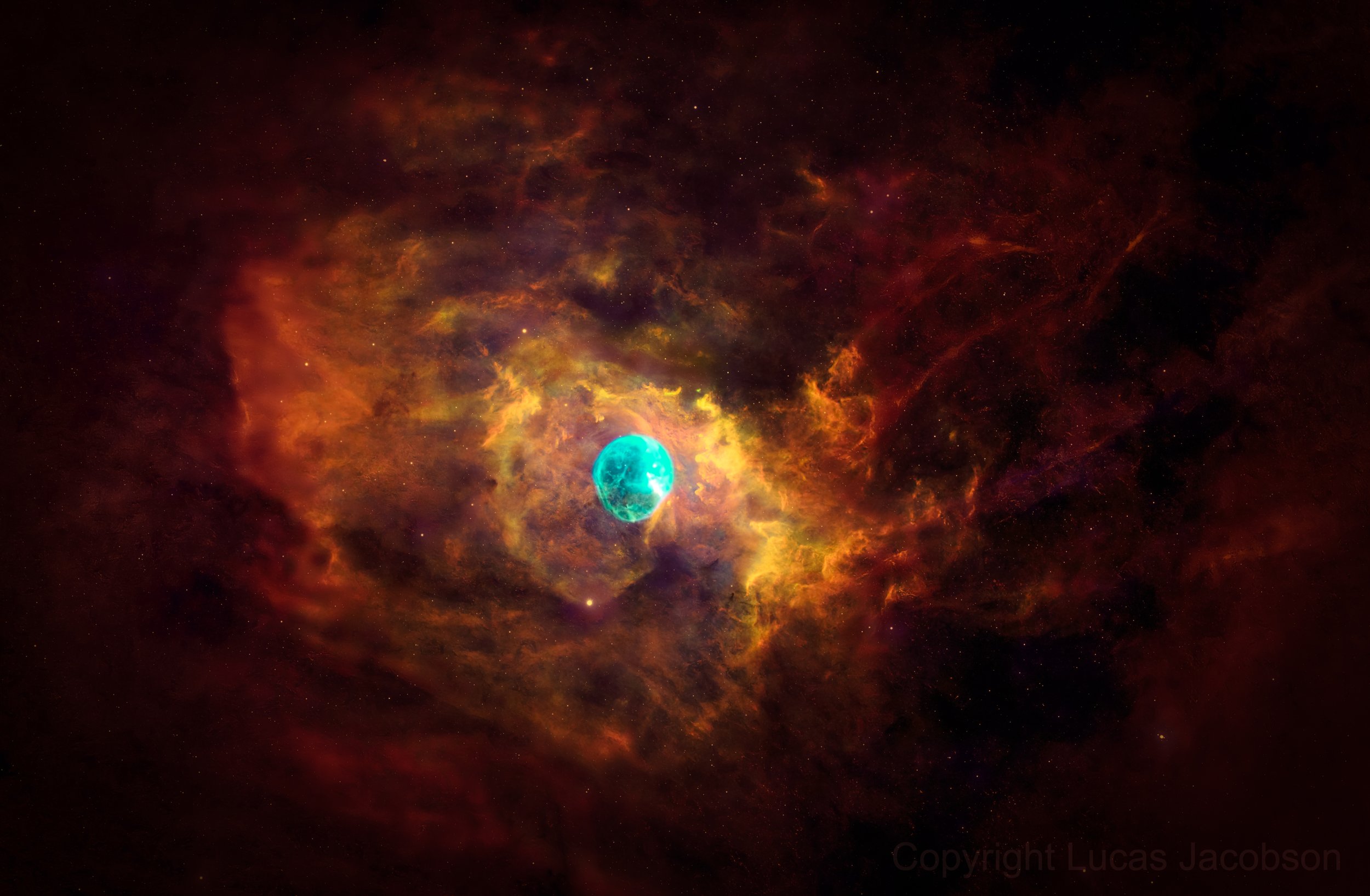
The Bubble Nebula is formed by the powerful stellar wind of a massive star, carving a cavity into the surrounding gas. What appears as a near-spherical “bubble” is the result of that wind pushing outward, compressing and heating the material at its boundary.
The central star drives this process continuously, sending high-energy particles outward at tremendous speeds, creating a shock front where the wind meets the surrounding nebula. This interaction defines the sharp, glowing edge of the bubble, while the interior remains comparatively diffuse.
This image uses narrowband imaging to separate light emitted by different elements within the gas. Sulfur, hydrogen, and oxygen are mapped into visible color to reveal structure that would otherwise be difficult to distinguish. The warmer tones trace denser, more complex regions of gas, while cooler hues highlight areas where the energy of the stellar wind is more pronounced.
Beyond the bubble itself, the surrounding nebula is far from uniform. Turbulent structures, filaments, and dark pockets of dust show that the star is not expanding into empty space, but into an environment already shaped by prior activity. The result is an asymmetric form—less a perfect sphere, and more a collision between outward pressure and existing structure.
The “bubble” is therefore not static, but a moment within an ongoing process—where energy from a single star continues to reshape its surroundings over time.