
click the image to view fullscreen
NGC 7635 – The Bubble Nebula in Context
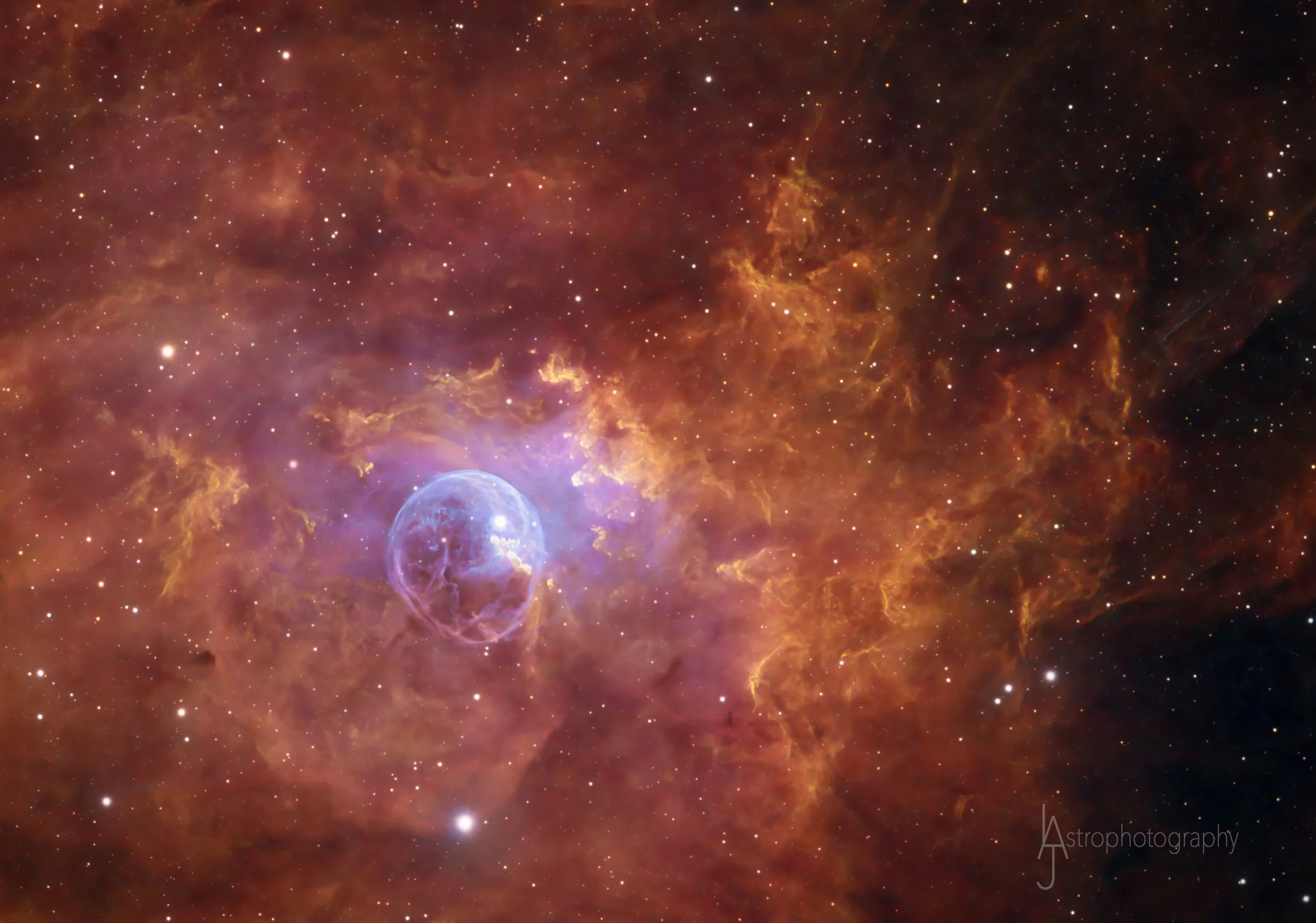
Approximately 7,100 light-years away in the constellation Cassiopeia, the Bubble Nebula is a remarkable example of the enormous influence a single massive star can have on its surroundings. At its heart, the young, extremely hot star BD+60°2522 produces an intense stellar wind that drives outward into the surrounding interstellar gas, carving an expanding cavity roughly seven light-years across.
The bubble's delicate shell marks the boundary where this powerful wind encounters denser material in the surrounding molecular cloud. Differences in gas density, pressure, and the interaction of shock fronts create the intricate filaments and turbulent structures visible throughout the region. The star's intense ultraviolet radiation also ionizes the surrounding hydrogen and oxygen, illuminating the cloud across a much larger area than the bubble itself.
This image combines narrowband, hydrogen, oxygen, and sulphur emission data with broadband color to reveal the relationship between the brilliant shell and the expansive nebula surrounding it. Particular attention was given to preserving the fine structure within the bubble, the delicate filament extending behind it, and the natural brightness hierarchy of the surrounding gas.
The result is a portrait of flowing energy where the radiation and stellar wind of a single star are actively reshaping the environment from which it was born.