
click the image to view fullscreen
NGC 6543 – A Tale of Two Cat’s Eyes
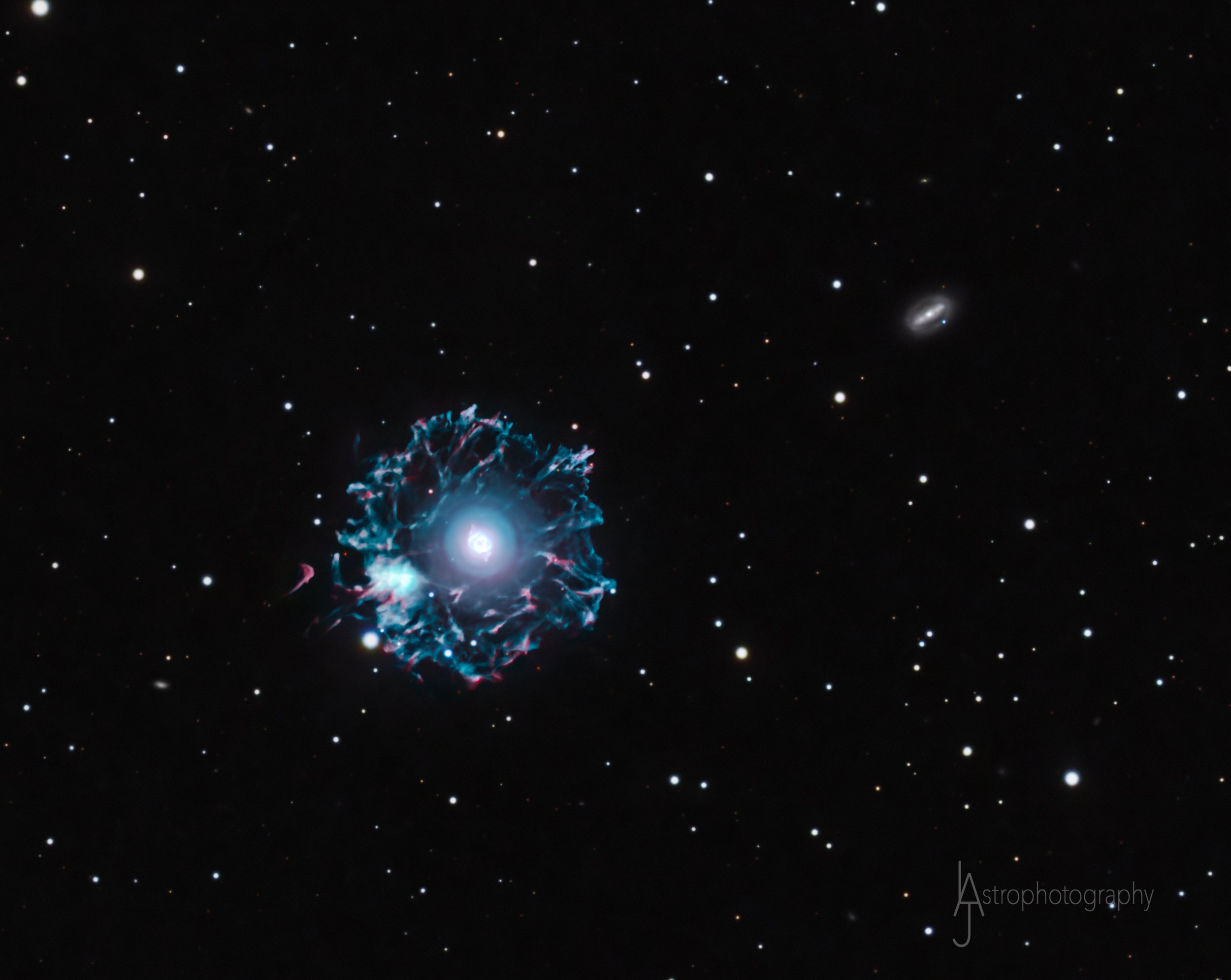
Approximately 3,300 light-years away in the constellation Draco, the Cat’s Eye Nebula is one of the most structurally complex planetary nebulae in our galaxy. Formed as a dying star expelled its outer atmosphere, NGC 6543 reveals an extraordinary history of stellar mass loss, shaped by interacting winds, shock fronts, and possibly the influence of a companion star.
At its center, a brilliant network of overlapping shells, arcs, and filaments surrounds the hot stellar remnant. Beyond this intricate core lies a much older, fainter halo of expelled material, recording earlier stages of the star’s evolution.
Sharing the composition is a distant background galaxy whose own structure bears a striking resemblance to an eye. The coincidence creates a fascinating juxtaposition: two celestial eyes formed by entirely different physical processes. One is the expanding atmosphere of a dying star within our own galaxy; the other is an immense collection of stars, gas, and dust far beyond the Milky Way.
Captured using a Celestron EdgeHD 9.25, this image combines long-exposure oxygen and hydrogen emission data with shorter exposures to preserve the brilliant central detail, alongside broadband data revealing the surrounding stars and distant galaxy.
Together, these two cosmic eyes offer a remarkable contrast in scale, distance, and the physical forces that shape our universe.