
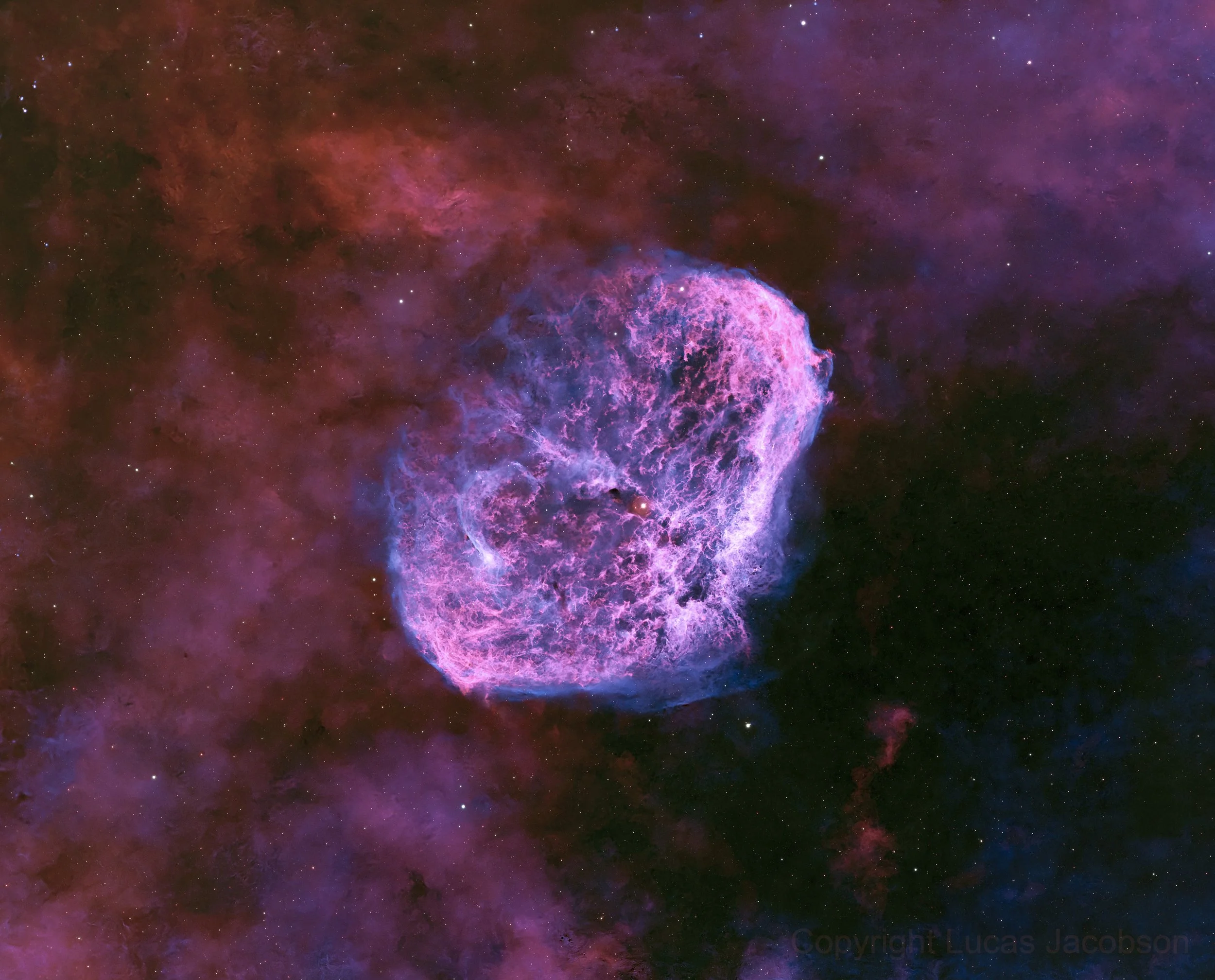
click the image to view fullscreen
The Crescent Nebula — A Collision of Stellar Winds
The Crescent Nebula is formed by the powerful winds of a massive star nearing the end of its life. As the star evolved, it expelled material during an earlier phase, creating a slower-moving envelope of gas. Later, a faster, more energetic stellar wind caught up with that older material, compressing and shaping it into the structure seen here.
The result is not a uniform shell, but a turbulent boundary—where newer, faster wind collides with older ejecta. The bright, curved edge traces this interaction, marking a region where gas is compressed, heated, and made to glow.
In this narrowband rendering, different elements reveal different layers of that collision. Hydrogen defines much of the surrounding structure, while oxygen highlights the sharper, more energetic regions along the shock front. Together, they show not just the shape of the nebula, but the forces actively shaping it.
Beyond the bright crescent itself, the surrounding field is filled with diffuse gas and faint structure, emphasizing that this interaction extends well beyond the most visible boundary. The nebula is not a closed object, but part of a larger environment still being reshaped by the star at its center.
The Crescent is therefore not simply the remnant of a past event—it is an ongoing process, where successive layers of stellar wind continue to interact, compress, and transform the surrounding material.