
click the image to view fullscreen
The Crescent to WR-134
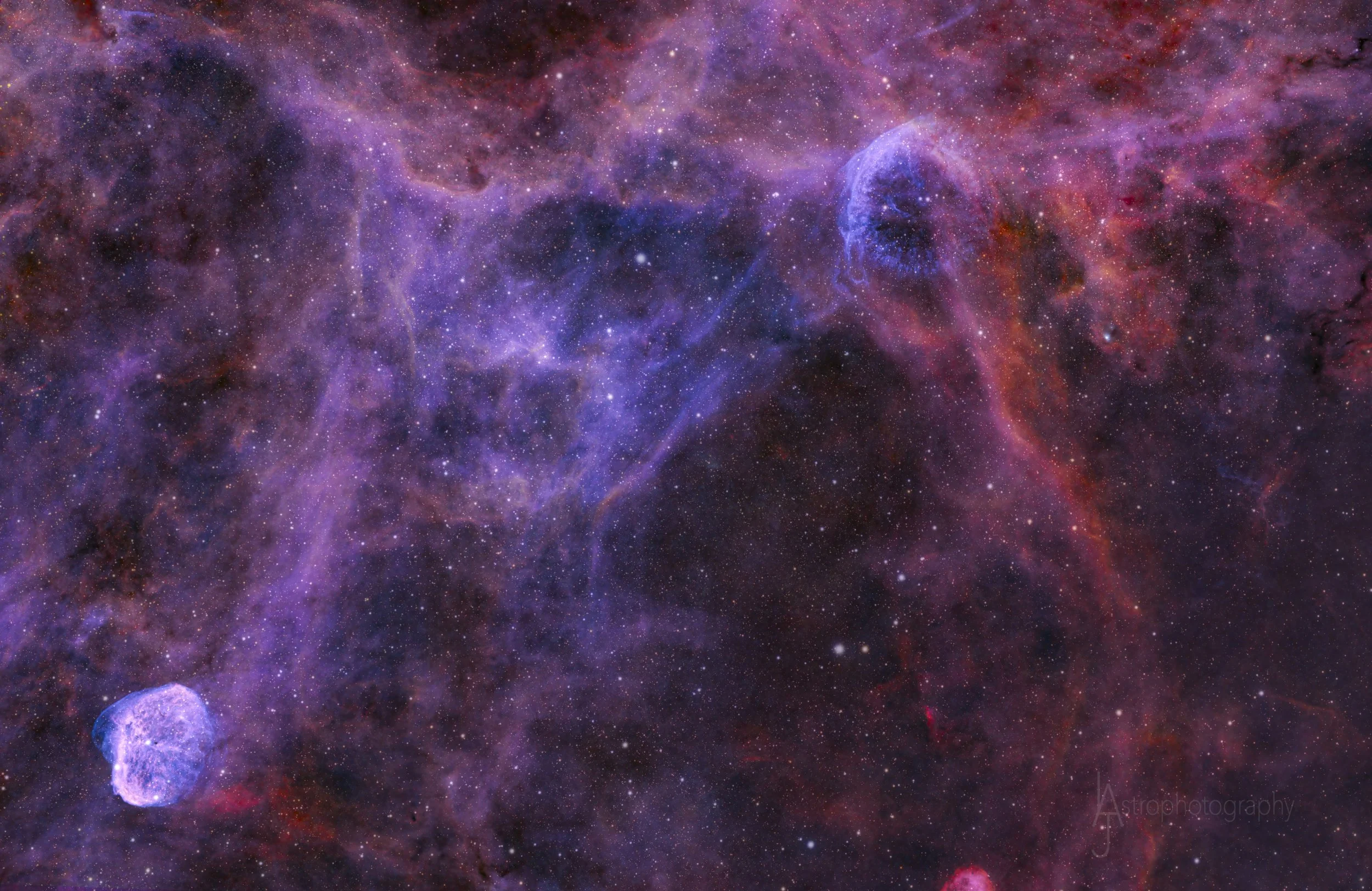
The Crescent Nebula and WR 134 share a field shaped by some of the most powerful stars in the Milky Way.
At left, the Crescent Nebula, NGC 6888, is the visible result of a Wolf-Rayet star shedding its outer layers into material expelled earlier in its life. Fast stellar winds collide with that older material, compressing and ionizing it into the bright shell and intricate network of filaments we see today. The strong sulfur emission along portions of the Crescent traces genuine differences in the structure and excitation of the expanding shell.
To the right lies WR 134, another Wolf-Rayet star surrounded by a much fainter bubble of ionized gas. Its delicate arc is easy to overlook against the enormous amount of emission filling this region of Cygnus, but it reveals the same fundamental process on a subtler scale: a massive, evolved star sculpting the interstellar medium around it.
What drew me to this composition was not simply the two objects, but the environment connecting them. Hydrogen, oxygen, and sulfur emission extend throughout the frame, turning what can appear to be isolated nebulae into features within a much larger and more complex landscape.
I processed the image with that relationship in mind. Rather than pushing the sulfur signal into the strong gold tones often associated with narrowband imagery, I kept its contribution more restrained, allowing it to reveal differences in the gas without dominating them. The oxygen remains similarly subdued where the data is faint. The result is intended to preserve the enormous dynamic range of the field—from the bright, tangled structure of the Crescent to the ghostlike shell surrounding WR 134 and the faint emission connecting everything between them.
For me, this image is ultimately less about two nebulae than about stellar energy written into the surrounding interstellar medium—two dying massive stars, their winds, and the traces of their evolution spread across a single field of sky.