
click the image to view fullscreen
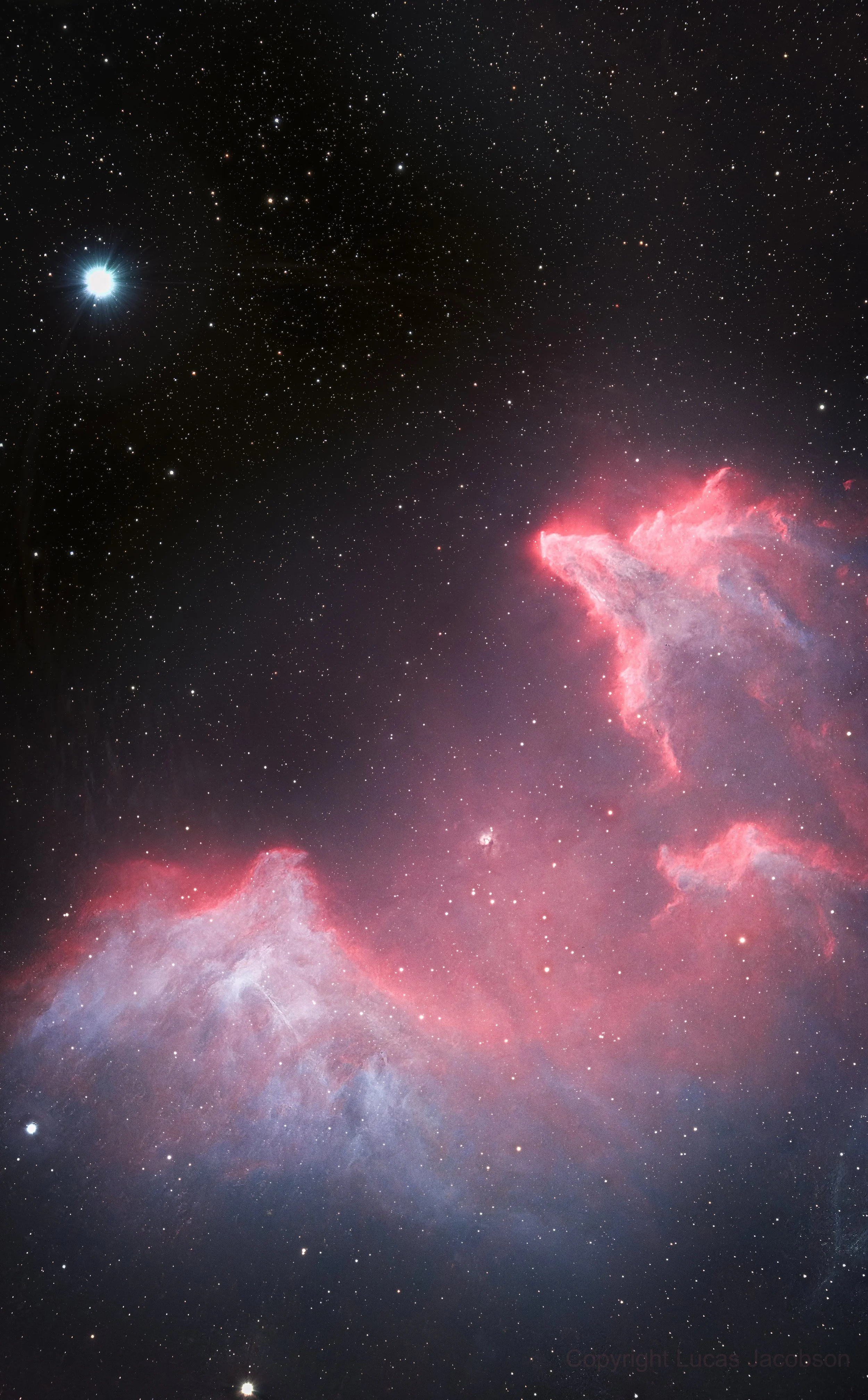
Ghosts of Cassiopeia — Light in the Wake of a Star
Often called the “Ghosts of Cassiopeia,” this faint, flowing structure is part of the diffuse nebular complex surrounding the bright star Gamma Cassiopeiae. The name is fitting—these wisps are not dense, glowing clouds like classic emission nebulae, but delicate sheets of gas and dust revealed by light rather than producing it.
Here, the dominant process is reflection. Dust suspended in space scatters the intense light from Gamma Cassiopeiae, creating the soft blue-white glow that drifts through the lower portions of the frame. Unlike hydrogen emission, which glows red due to ionization, reflection nebulae preserve the color of the illuminating star—cooler, more ethereal, and often harder to detect.
The red structures threading through the scene tell a different story. These are regions where hydrogen gas is being energized and ionized, emitting its characteristic deep red light. Together, the image reveals two overlapping physical processes: reflection from dust and emission from energized gas, coexisting within the same region of space.
The “ghostly” appearance comes from both structure and scale. These filaments are thin, semi-transparent, and spread across vast distances, with no sharp boundaries—only gradients shaped by radiation, density, and the geometry of the surrounding interstellar medium. What looks like drifting smoke is, in reality, a complex interplay of light and matter sculpted over time.
Even the bright star itself contributes to the composition beyond illumination. Its intense brilliance introduces subtle optical artifacts—diffraction patterns and scattered light—that remind us this image is not only a view of the cosmos, but also a product of the instrument capturing it.
In this scene, nothing is static. Light is being scattered, gas is being energized, and structure is continuously reshaped by radiation. The “ghosts” are not objects, but moments—brief, luminous traces of an ongoing interaction between stars and the space around them.