
Click for full screen image
The Iris — Light, Dust, and Reflection
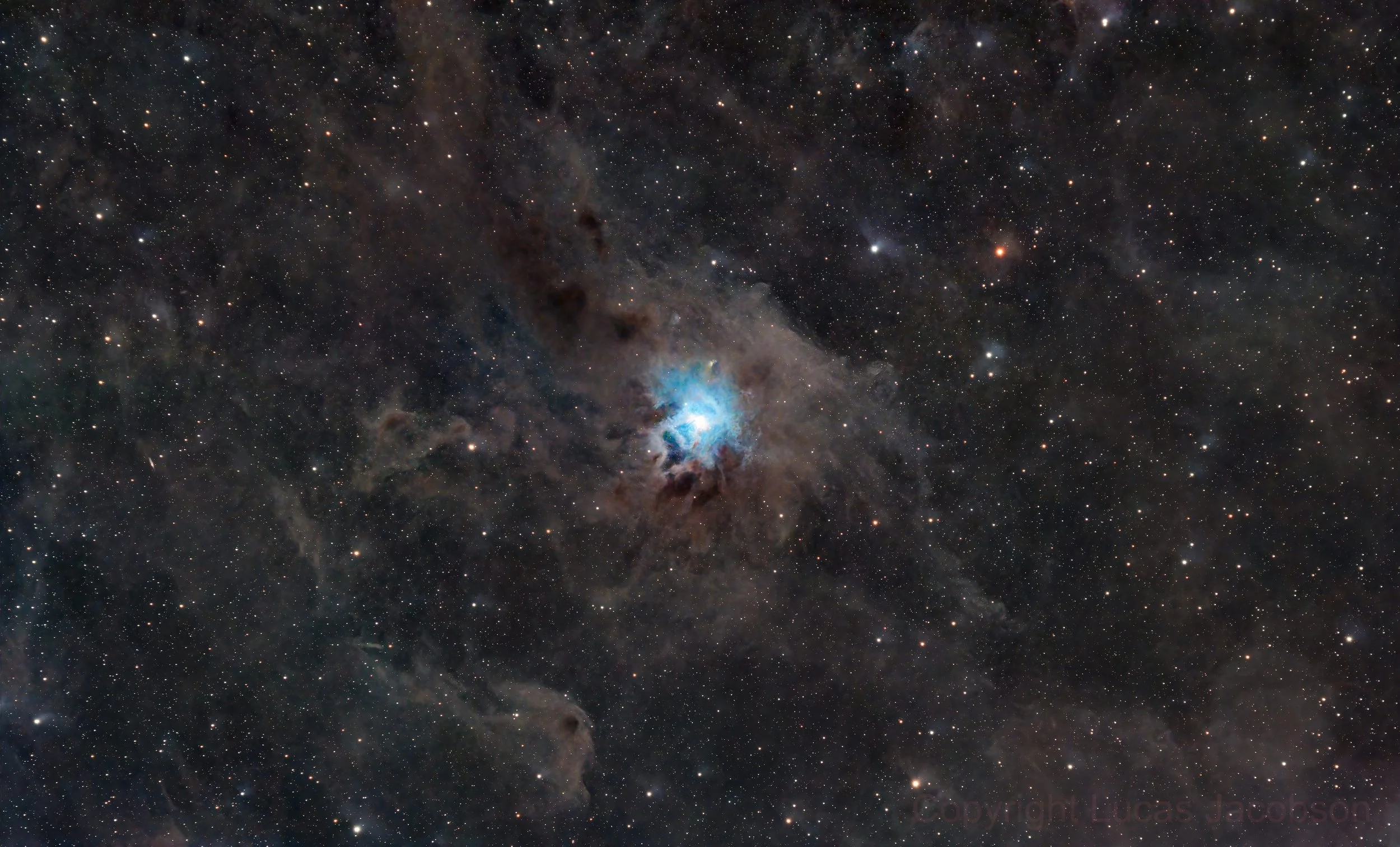
Centered in this field is the Iris Nebula, a reflection nebula illuminated by a nearby bright star. Unlike emission nebulae, which glow from energized gas, the Iris shines by scattering starlight off surrounding dust—much like sunlight diffused through a thin cloud.
The blue tones at its core are the result of that scattering, where shorter wavelengths of light are reflected more efficiently. Surrounding it, darker lanes and wisps of dust absorb and redirect that light, revealing the structure of the interstellar medium in layers rather than sharp boundaries.
Extending outward, the nebula blends into a broader field of faint dust and background stars. This transition highlights that the Iris is not an isolated object, but a denser region within a much larger and more diffuse cloud.
Subtle halos around the brightest stars are visible in this image, caused by diffraction within the telescope itself—an interaction between light and the physical structure of the optics. While not part of the nebula, they serve as a reminder that every image is both a view of the universe and a product of the instrument used to capture it.
Together, the scene becomes a combination of astrophysical structure and observation—a balance between what is present in space and how it is revealed.