
click on the image to view fullscreen
Jellyfish and Monkey Head
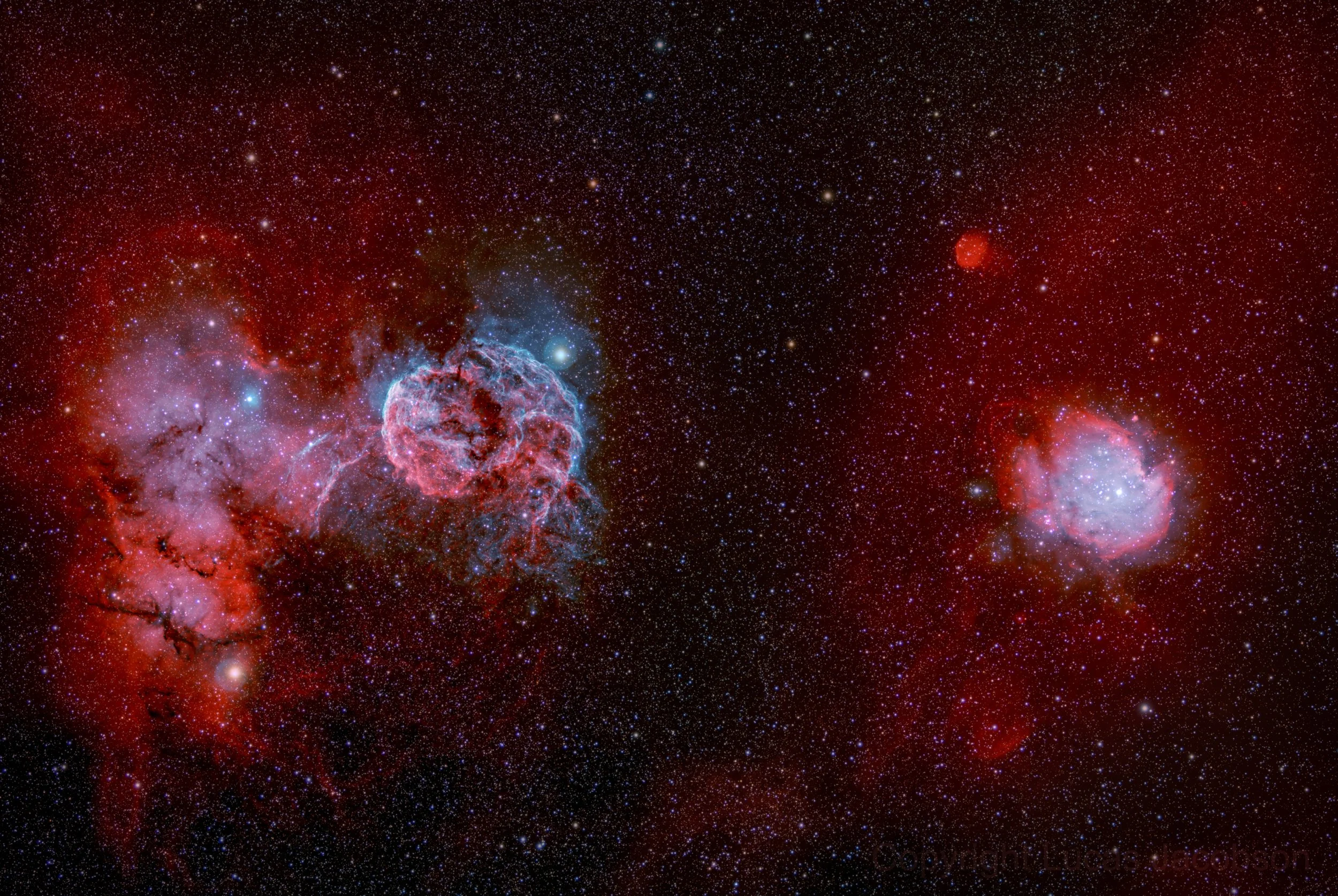
This field brings together two distinct nebulae within the same region of sky: the Jellyfish Nebula to the left and the Monkey Head Nebula to the right. Though separated in space, they appear together here as part of a broader environment shaped by stellar evolution.
The Jellyfish Nebula is the remnant of a supernova explosion—an expanding shell of gas driven outward by a shockwave from a massive star’s death. Its filamentary structure reveals that motion, with strands of material tracing the interaction between the expanding debris and the surrounding medium.
In contrast, the Monkey Head Nebula is a region of active star formation. Here, radiation from young stars energizes the surrounding hydrogen gas, causing it to glow while slowly reshaping the cloud. Its form is softer and more diffuse, reflecting a process of creation rather than destruction.
The surrounding field of red emission connects the two, hinting at a shared origin within a larger molecular cloud complex. One region shows the aftermath of a star’s life, while the other reflects the conditions that give rise to new ones.
Together, they present two phases of the same cycle—matter driven outward, redistributed, and eventually drawn back together to form the next generation of stars.