
click the image to view fullscreen
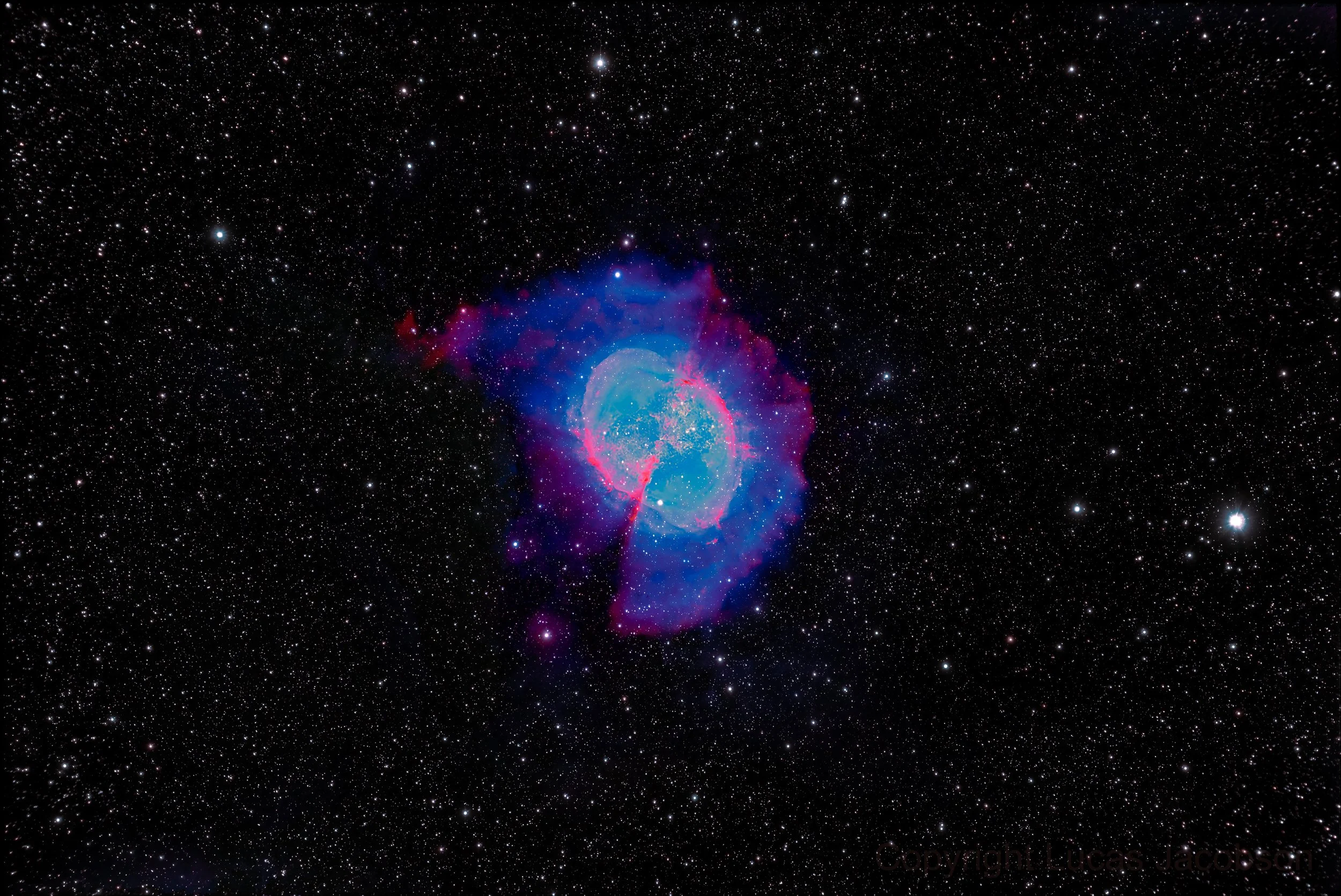
The Dumbbell Nebula
M27, a planetary nebula, forms as a Sun-like star reaches the end of its life. What appears here as a luminous, structured cloud is the outer atmosphere of that star, expelled into space and illuminated from within by its exposed core.
At the center lies a white dwarf, the dense remnant of the original star. Its intense ultraviolet radiation excites the surrounding gas, causing it to glow in distinct colors tied to atomic physics. Hydrogen dominates the outer regions, while oxygen—energized by higher-energy radiation—traces the inner shells and shock fronts closer to the core.
In this rendering, those energy layers are separated visually. Hydrogen emission contributes to the magenta tones that define the nebula’s broader shape, while oxygen appears in the cooler cyan-blue core, revealing where the radiation is most intense. The result is a stratified structure: not random, but ordered by energy, density, and distance from the dying star.
The familiar “dumbbell” shape is only part of the story. What looks like a simple form is actually a three-dimensional outflow—likely bipolar—seen from an angle. Fainter outer shells extend beyond the bright core, evidence of earlier mass-loss episodes that now drift farther into interstellar space.
This is a transitional moment in stellar evolution. Over time, the nebula will disperse, its material mixing back into the galaxy, enriching future generations of stars and planets. What remains at the center will cool slowly over billions of years, no longer shining through fusion, but still carrying the mass and heat of a once-luminous star.