
click the image to view fullscreen
The Andromeda Galaxy — A Structure Across Scale
The Andromeda Galaxy is the nearest large spiral galaxy to our own, a vast system of stars, gas, and dust spanning over 200,000 light-years. Though visible to the naked eye under dark skies, its true scale only becomes apparent when seen in detail.
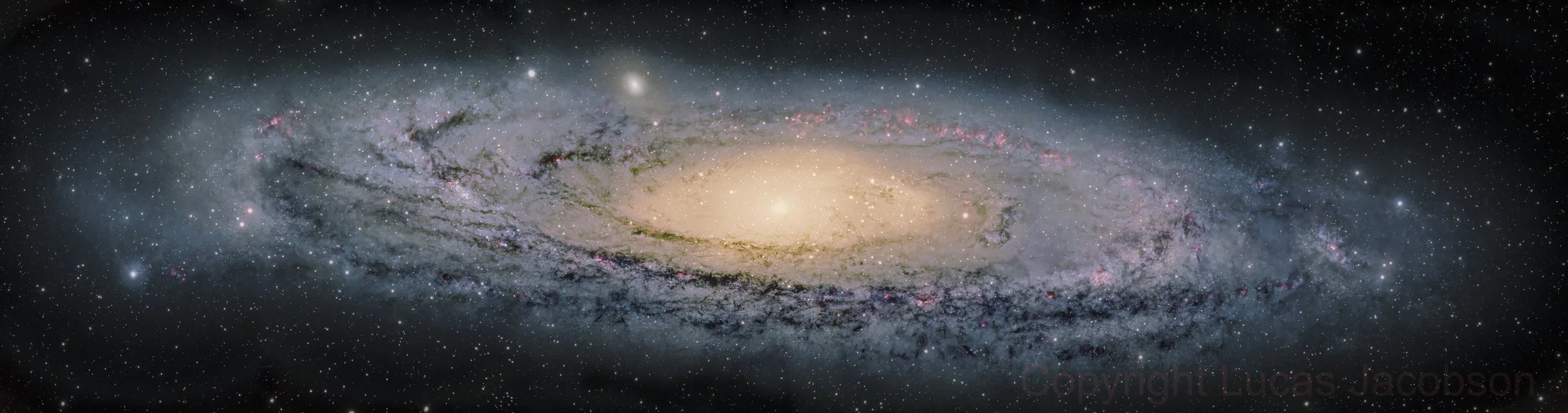
This image is a mosaic, combining multiple fields into a single view that captures the full extent of the galaxy’s disk. The bright central bulge marks a dense concentration of older stars, gradually giving way to sweeping spiral arms rich with gas, dust, and ongoing star formation.
Dark lanes weave through those arms, tracing regions where interstellar dust obscures the light behind it. Interspersed within the structure are faint pink regions—sites where new stars are forming, their radiation energizing surrounding hydrogen gas.
Beyond the main disk, the galaxy does not end abruptly. Its outer regions fade into a diffuse halo, where stars become more sparsely distributed and the boundary between galaxy and surrounding space begins to blur. Subtle variations in brightness hint at the larger structure extending beyond what is immediately visible.
Andromeda is not an isolated system. It is surrounded by smaller satellite galaxies and embedded within a larger gravitational environment, slowly interacting and evolving over time. It is also moving toward us, part of a long-term interaction that will eventually reshape both it and the Milky Way.
This image captures not just a galaxy, but a system—one that exists on a scale difficult to grasp, yet revealed here through structure, contrast, and light accumulated over time.