
click the image to view fullscreen
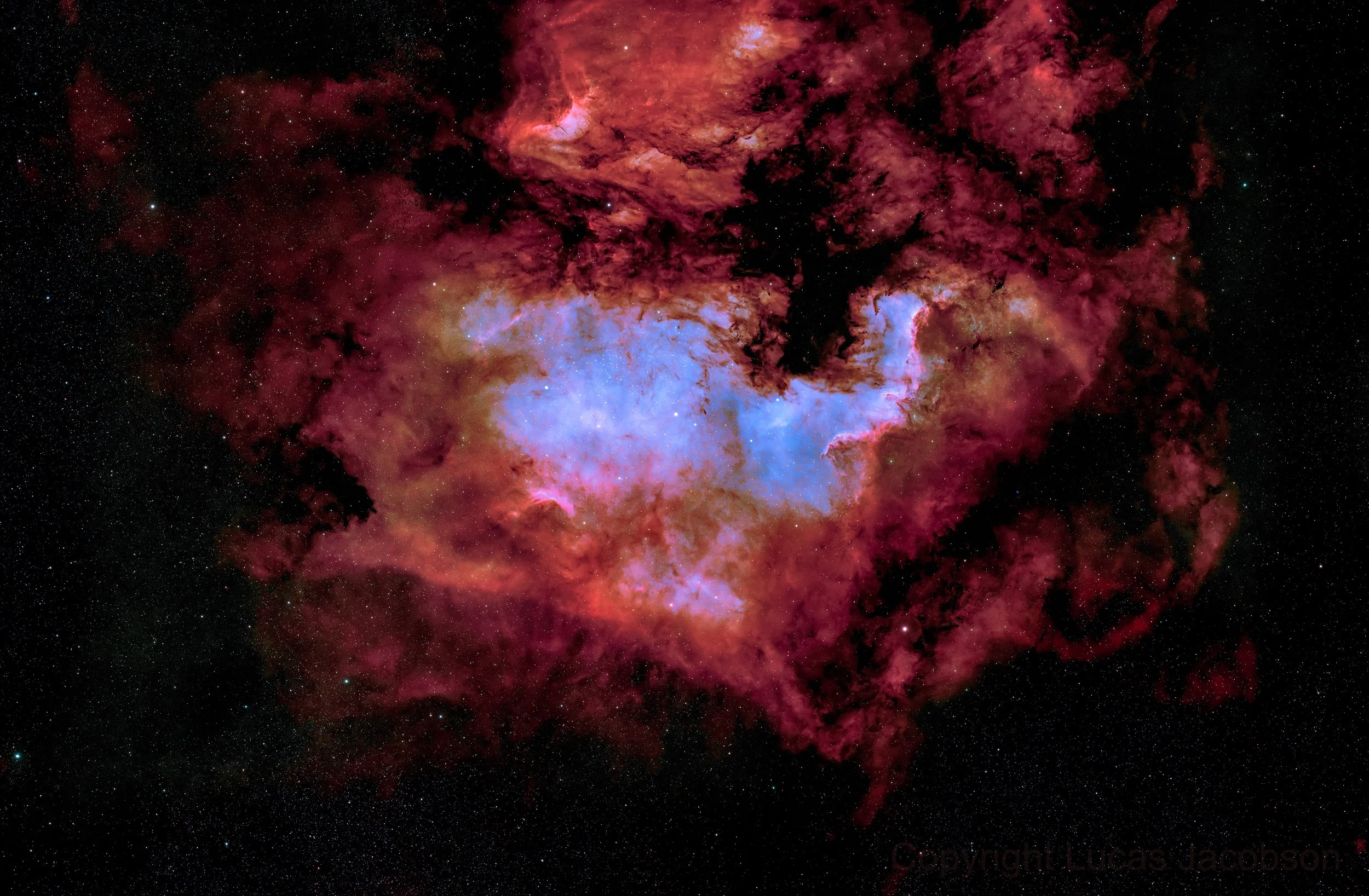
The North America Nebula — A Continent of Star Formation
Spanning a vast region of the Milky Way, the North America Nebula is an immense cloud of ionized hydrogen gas, its familiar outline shaped by both illumination and obscuration. The dark silhouette that defines its “coastline” is not empty space, but dense foreground dust—blocking light and carving the nebula into something recognizable from our perspective.
At the heart of this structure lies an energetic engine: radiation from nearby massive stars—particularly those associated with Deneb—is responsible for ionizing the surrounding gas. As hydrogen atoms recombine, they emit the deep red glow that dominates the field, tracing the full extent of this enormous star-forming region.
In this rendering, color separates energy from structure. Hydrogen defines the broad, red expanse of the cloud, while oxygen emission appears as cooler blue tones concentrated in regions where the gas is more highly energized or thinned. These transitions reveal boundaries—interfaces where radiation, density, and motion meet.
The brightest and most active region is a site of ongoing star formation. Here, radiation compresses nearby gas, triggering collapse in some regions while eroding others. The result is a constantly evolving landscape—pillars, ridges, and voids shaped by competing forces.
Dark filaments weave through the scene, marking the densest pockets of dust. These structures both obscure and define the nebula, acting as the raw material for future stars while simultaneously sculpting the light we see.
The North America Nebula is less an object than a process—a vast, illuminated section of the galaxy where star formation, radiation, and structure are all unfolding at once.