
click the image to view fullscreen
Orion — A Study in Energy and Contrast
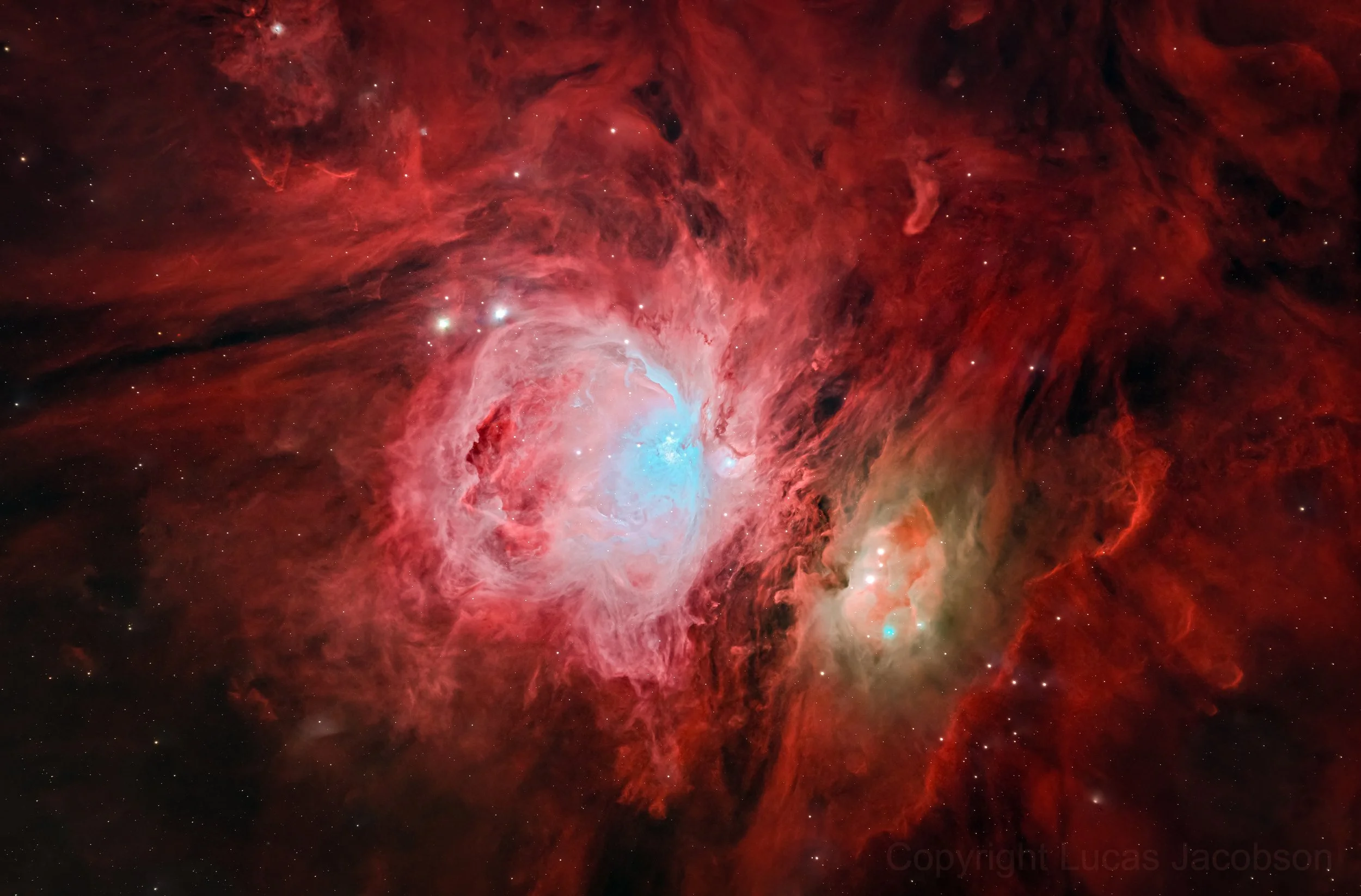
At the heart of this image lies the Orion Nebula, one of the most active and well-studied stellar nurseries in the night sky. But in this interpretation, the familiar has been reimagined—rendered not just as a place, but as a field of energy.
The dominant reds trace vast regions of ionized hydrogen, glowing under the influence of intense ultraviolet radiation from newly formed stars. These outer layers are expansive and diffuse, revealing the full reach of the nebula’s influence as it pushes outward into surrounding space.
At the core, the color shifts dramatically. Oxygen emission—energized by the highest-energy radiation—emerges in cooler cyan tones, marking regions closest to the most powerful sources of light. This transition from red to blue is not arbitrary; it maps a gradient of energy, from broad ionization to concentrated excitation.
Embedded within this luminous cloud is the Trapezium Cluster, a group of young, massive stars whose radiation and stellar winds are actively sculpting the nebula. Their influence carves cavities, drives shock fronts, and compresses nearby gas, triggering new waves of star formation even as they erode the material around them.
To the right, the neighboring Running Man Nebula appears more subdued, its softer glow shaped more by reflection than emission. Together, these regions highlight different physical processes occurring within the same complex—one dominated by ionization, the other by scattered starlight.
This “hot” rendering leans into those physical differences, exaggerating contrast to emphasize structure and energy. It transforms Orion from a familiar winter target into something more visceral—an environment in motion, where radiation, gravity, and matter are locked in continuous interaction.