
click the image to view fullscreen
The Orion Nebula — Formation in Detail
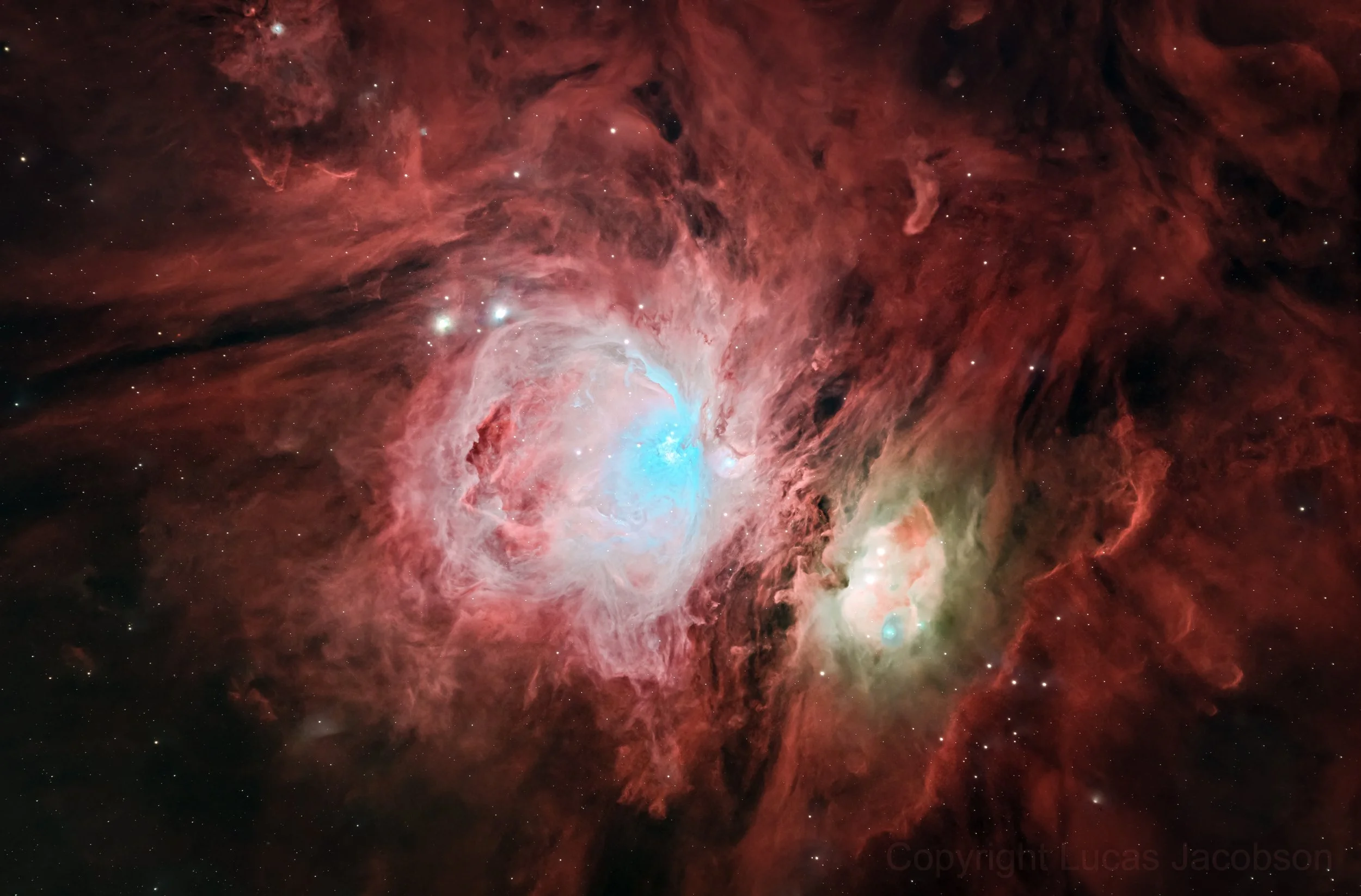
At the center of this image lies the Orion Nebula, one of the nearest and most active regions of star formation in the night sky. Here, gravity, radiation, and gas interact on a scale where new stars are actively forming and reshaping their surroundings.
The bright central region is illuminated by a young cluster of stars embedded within the nebula. Their intense radiation ionizes the surrounding hydrogen gas, causing it to glow while simultaneously pushing material outward. This creates a layered structure—dense regions resisting that pressure, while more diffuse gas is swept and shaped into flowing forms.
Adjacent to the core, the Running Man Nebula appears as a contrasting region of softer illumination, where reflection and emission combine to reveal a more diffuse structure. Together, these regions show different responses to the same underlying forces.
Color in this rendering separates those layers. Hydrogen defines the broader red structure of the cloud, while oxygen highlights the more energetic regions closer to the central stars. The transition between them reveals how energy moves outward, shaping the nebula over time.
Dark lanes and filaments cut through the scene, marking denser pockets of dust that absorb and redirect light. These structures are not static—they are part of an evolving system, where material may eventually collapse to form new stars.
The Orion Nebula is not simply a bright cloud, but a dynamic environment—capturing multiple stages of stellar formation and transformation within a single region.