
click the image to view fullscreen
Rosette Nebula — Interpreted in Color
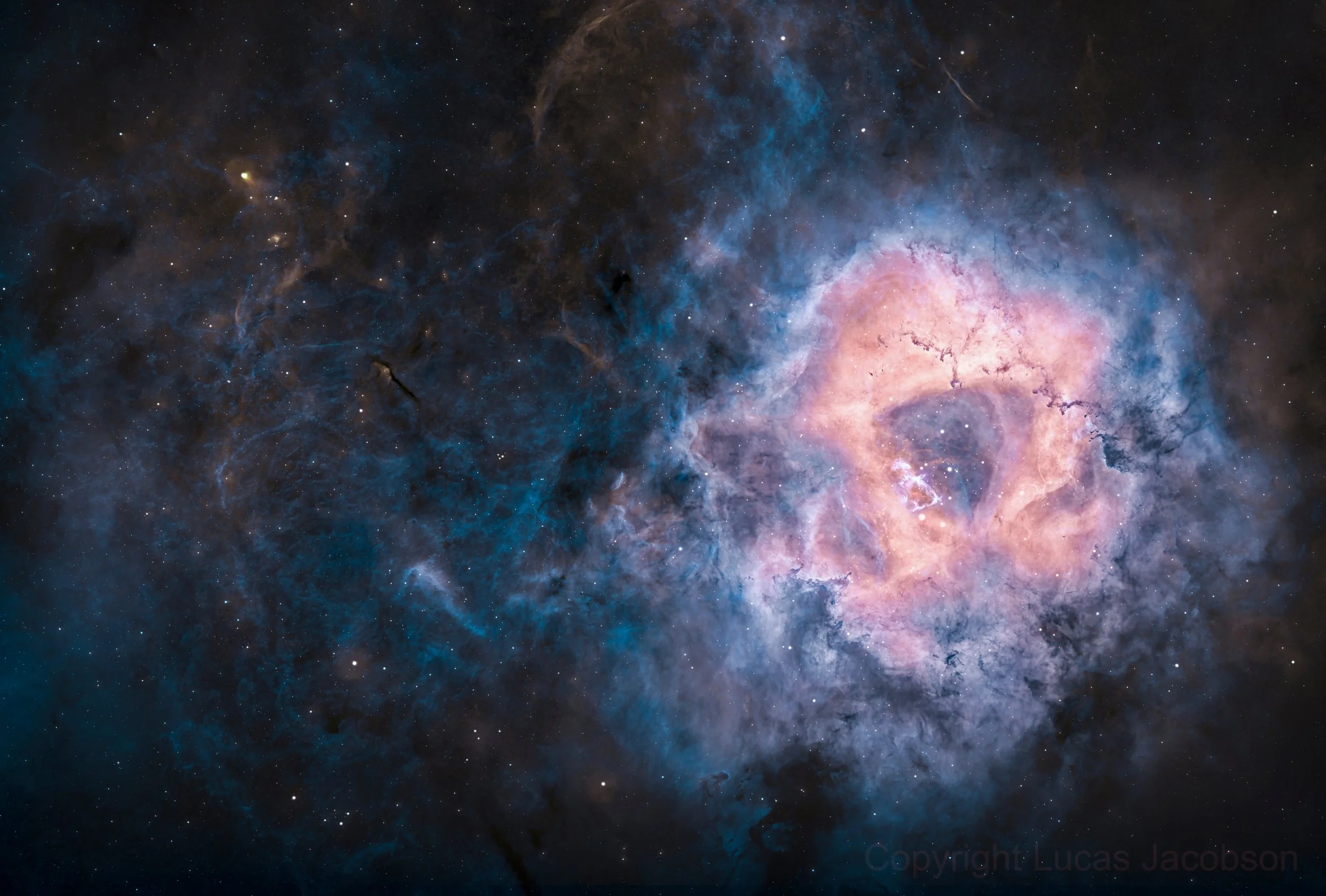
The Rosette Nebula is a vast stellar nursery shaped by the radiation of young stars at its center. Their energy carves a cavity through the surrounding gas, illuminating layers of hydrogen and oxygen as the nebula expands outward into space.
In this interpretation, color is used with deliberate artistic license. Oxygen emission is loosely carried into the warmer red and rose tones, while hydrogen is shifted toward cooler blue and violet hues. The result is not a natural-color view, but a structural interpretation—one designed to separate the layers of gas and emphasize the movement, depth, and turbulence within the nebula.
Dark filaments cut through the glowing material, marking denser regions of dust that resist the outward pressure from the central cluster. Around them, the surrounding gas appears almost translucent, revealing the Rosette as a dynamic system rather than a flat celestial object.
This rendering explores the nebula as both science and art: real emission data, interpreted through color to reveal form, contrast, and motion.