
click the image to view fullscreen
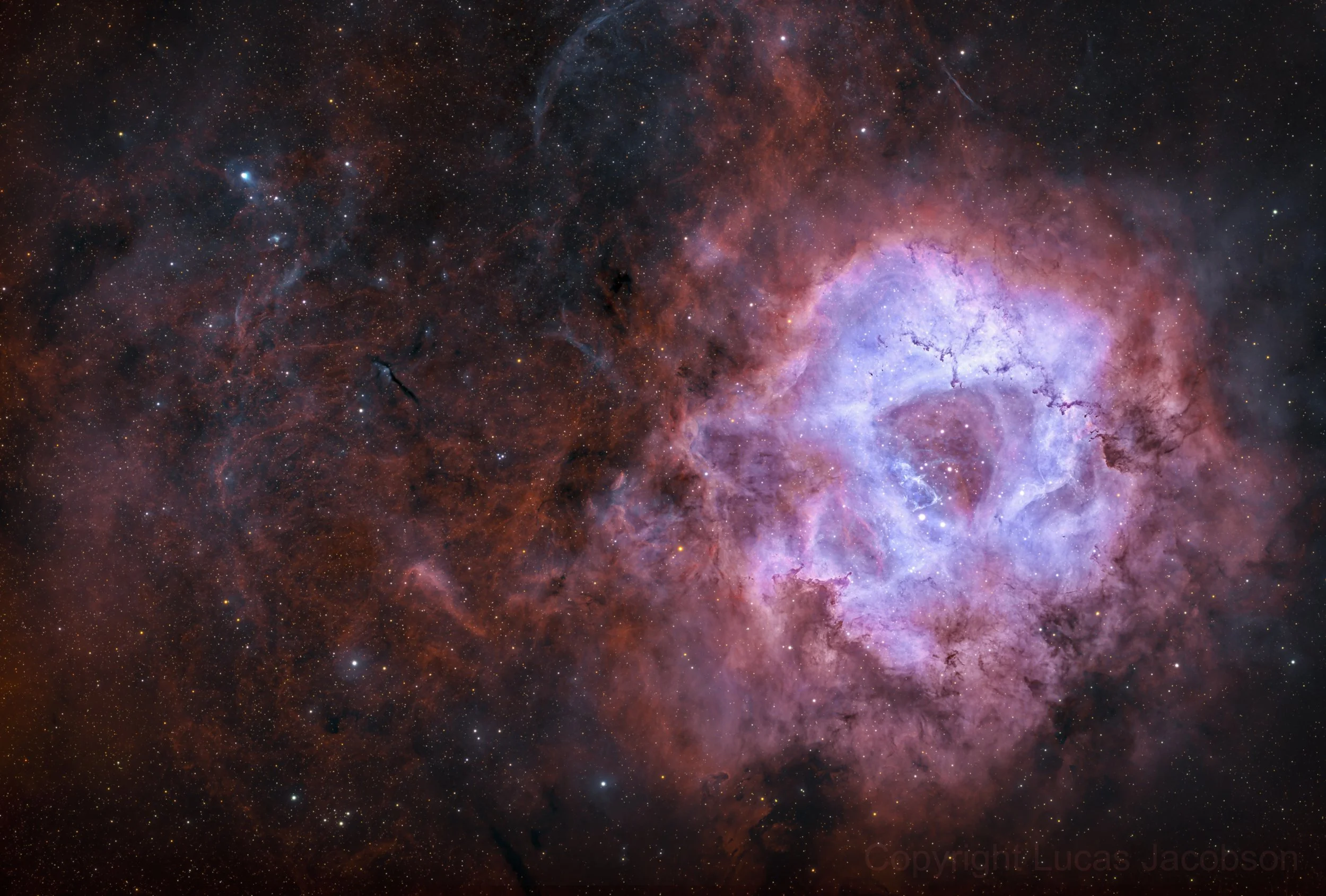
Rosette Nebula — Layers of Ionized Light
The Rosette Nebula is a vast region of gas and dust shaped by the energy of young stars at its core. What appears as a soft, flower-like structure is in reality an active environment where radiation and stellar winds are sculpting the surrounding material.
The deep red tones trace hydrogen gas energized by intense ultraviolet radiation, while the cooler blue hues reveal oxygen emission pushed outward into the surrounding space. Together, these layers show the outward flow of energy—where newly formed stars are clearing cavities and driving ionization fronts through the nebula.
Dark filaments weave through the structure, marking denser regions of dust that resist this expansion. These shadows hint at future star formation, where gravity may eventually overcome the outward pressure and begin the cycle again.
This image presents the Rosette not as a single object, but as a system in motion—an interplay of light, matter, and time unfolding across hundreds of light-years.