
click the image to view fullscreen
The Tadpoles — Hydrogen as Structure, Oxygen as Contrast
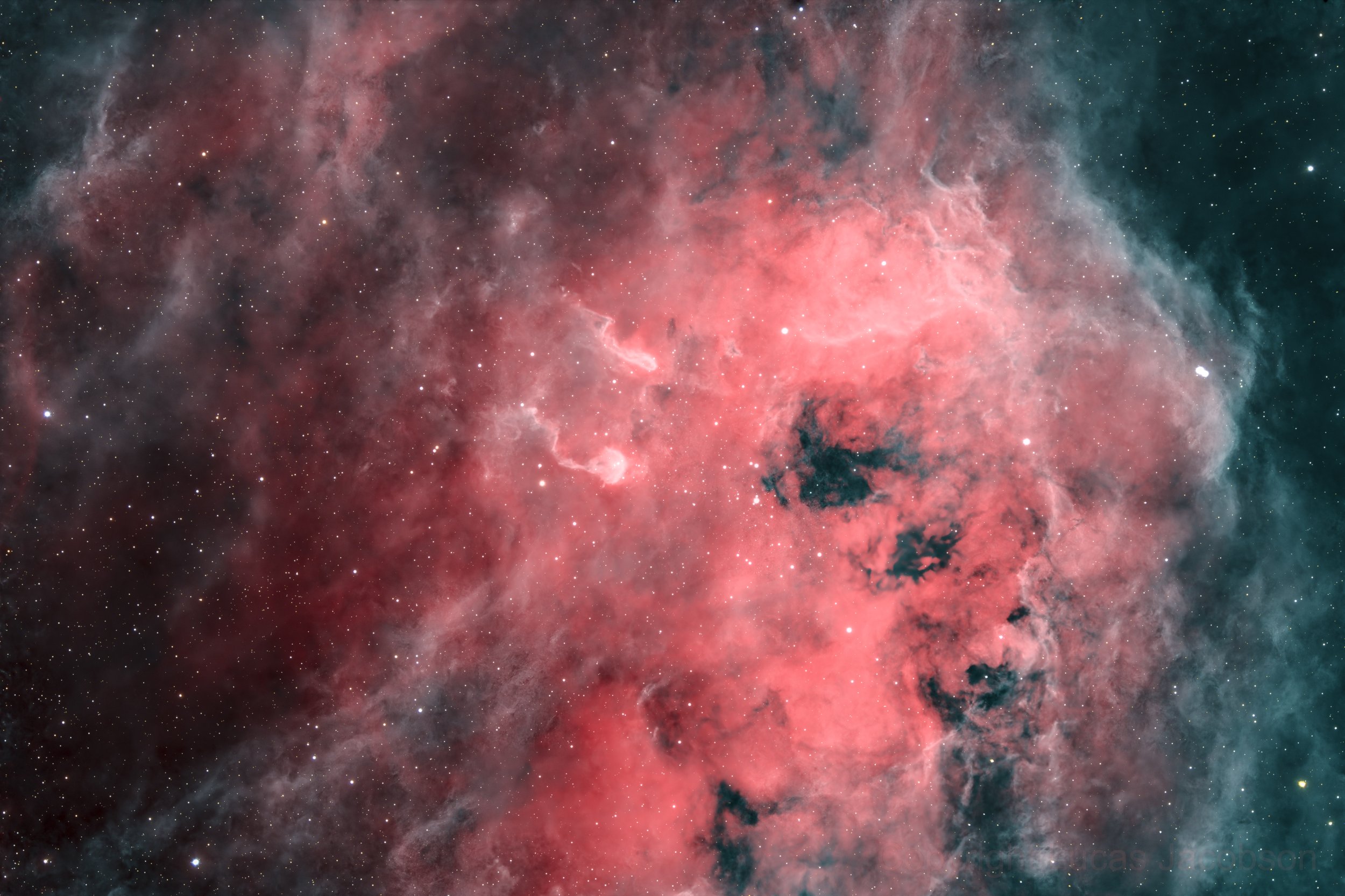
The Tadpole Nebula is a region shaped by intense radiation from young stars, where dense knots of gas resist that energy and are gradually eroded into elongated, tail-like structures. These “tadpoles” are not static features, but temporary forms created as material is stripped away and pushed outward over time.
This image uses a narrowband approach that isolates light from specific elements within the nebula. In this interpretation, hydrogen—the dominant component of the cloud—is mapped equally into all three color channels, allowing it to appear as a neutral white. This creates a continuous foundation that defines the overall structure of the nebula.
Oxygen emission is mapped into red, providing contrast against that neutral base. Rather than representing density alone, these red regions trace where conditions differ—highlighting areas where energy, temperature, or excitation levels vary within the gas.
This mapping separates structure from variation. The white hydrogen defines the form of the nebula, while the red oxygen reveals where that structure is being altered, energized, or disrupted.
Dark filaments cut through the scene, marking dense regions of dust that block and redirect radiation. Around them, the surrounding gas appears layered and fluid, emphasizing that this is an evolving system shaped by competing forces over time.
This rendering is not a natural-color view, but a deliberate interpretation—one that uses color to distinguish the underlying structure from the processes actively reshaping it.